
AI-driven predictive analytics in PRINCE2 risk, issue, and exception management
Modern projects operate within increasingly dynamic delivery environments. Accelerated transformation initiatives, evolving stakeholder expectations, interconnected supplier ecosystems, and rapidly changing operational risks have made governance more challenging than ever before. While project reporting structures continue to improve, many organizations still rely heavily on retrospective information when making governance decisions.
In many cases, risks are escalated after delivery indicators have already deteriorated, issues become visible only once operational impact is felt, and exceptions are managed after tolerances are breached. This creates pressure on project boards, delivery teams, and assurance functions that must respond quickly within compressed decision timelines.
As organizations continue adopting data-driven operational practices, predictive analytics is beginning to influence how project governance visibility may evolve. Within PRINCE2, predictive analytics has the potential to strengthen risk, issue, and exception management by supporting earlier identification of delivery concerns and enabling more proactive governance intervention.
Importantly, predictive analytics should not be viewed as a replacement for professional judgement or governance accountability. Rather, it may enhance the effectiveness of existing PRINCE2 governance controls by improving visibility into emerging delivery trends before formal escalation becomes necessary.
From reactive governance to predictive visibility
Traditional governance models often depend on periodic reporting cycles, manual risk reviews, stakeholder updates, and retrospective performance analysis. While these controls remain essential, they may not always provide sufficient early warning in complex delivery environments where risks evolve rapidly across interconnected workstreams.
PRINCE2 already provides strong governance foundations through principles such as continued business justification, defined roles and responsibilities, and management by exception. The method also supports structured escalation pathways through tolerances, stage controls, assurance activities, and exception reporting.
However, the increasing volume of project delivery data now creates opportunities to identify patterns that previously remained hidden until later stages of project execution.
Evolution of Governance Visibility in PRINCE2 Environments
| Traditional Governance | AI-Driven Predictive Governance |
|---|---|
| Risks identified after reporting cycles | Risks anticipated through trend analysis |
| Manual issue escalation | Early issue correlation and prioritization |
| Reactive exception handling | Forecasted tolerance breach indicators |
| Delayed governance intervention | Proactive governance visibility |
| Static reporting dashboards | Dynamic predictive insight |
Predictive analytics may help project teams identify delivery trends earlier by analyzing recurring patterns across schedules, resource utilization, issue logs, dependencies, operational incidents, supplier performance, and historical project outcomes.
This does not eliminate the need for governance oversight. Instead, it may allow governance functions to focus attention earlier on areas where intervention could reduce the likelihood of escalation.
Predictive analytics in PRINCE2 risk management
Risk management remains one of the most important governance disciplines within PRINCE2. Project environments are often influenced by multiple internal and external uncertainties that evolve continuously throughout delivery.
Traditionally, risks are identified through workshops, stakeholder reviews, lessons learned, and periodic assessments. While these approaches remain valuable, predictive analytics may strengthen risk visibility by identifying delivery indicators that suggest an increased probability of future disruption.
For example, recurring schedule variance across critical activities may indicate increasing delivery instability. Resource overload patterns may suggest elevated operational risk. Repeated supplier delays across dependent workstreams may reveal systemic weaknesses that could later affect project tolerances.
Predictive analytics may therefore support earlier identification of emerging risks before they fully materialize within project reporting cycles.
This capability aligns particularly well with the PRINCE2 Risk practice, which emphasizes structured identification, assessment, response planning, and ongoing monitoring of uncertainty throughout the project lifecycle.
Predictive analytics in issue and exception management
Issue management within PRINCE2 focuses on identifying and controlling concerns that require management attention during delivery. In complex environments, however, issues rarely occur in isolation. Delivery concerns may emerge gradually across operational processes, supplier relationships, stakeholder communication channels, or technical dependencies.
Predictive analytics may help organizations correlate seemingly unrelated indicators to identify broader patterns of concern earlier.
For instance, increasing operational incidents, repeated approval delays, growing dependency conflicts, and declining milestone confidence may collectively indicate an increasing probability of future exception conditions.
This becomes particularly significant within the PRINCE2 principle of management by exception.
PRINCE2 enables governance efficiency by allowing project boards to delegate authority within agreed tolerances for cost, time, scope, quality, benefits, and risk. Formal escalation occurs only when those tolerances are forecast to be exceeded.
Predictive analytics may enhance this governance approach by identifying probable tolerance breaches before formal exception conditions arise.
Example of a Practitioner: Using Microsoft Copilot in a Telecommunications Delivery Programme
While the potential of predictive analytics is often discussed conceptually, my own experience highlighted how it can support governance discussions in a practical project environment.
During a telecommunications transformation programme involving the delivery of multiple network circuits across geographically dispersed locations, project information was distributed across supplier status reports, risk registers, issue logs, project schedules, governance packs, meeting minutes, and stakeholder communications.
Although programme reporting indicated that overall delivery remained within approved tolerance, recurring references to local access approvals, engineering rescheduling, supplier dependencies, and site-readiness concerns appeared across several independent reporting streams.
To improve visibility, Microsoft Copilot was used to assist with reviewing and consolidating information from project documentation, supplier updates, governance reports, meeting notes, and stakeholder communications.
Importantly, Copilot was not used to make governance decisions or replace project controls. Instead, it acted as a decision-support capability by helping identify recurring themes and relationships across information sources that would otherwise have required significant manual analysis.
The review highlighted a pattern of dependency-related delays affecting multiple circuit deliveries. Individually, each delay appeared manageable and did not warrant formal escalation. However, when viewed collectively, the information suggested increasing schedule pressure within a critical delivery stage.
This observation prompted additional governance discussions regarding supplier performance, dependency management, escalation routes, and delivery assumptions. The project team subsequently increased monitoring of affected workstreams, reviewed mitigation activities, and engaged suppliers earlier than originally planned.
At that stage, no formal exception had been raised. However, the additional visibility enabled proactive intervention before delivery tolerances were significantly affected.
The experience demonstrated that predictive analytics delivered its greatest value through improved visibility instead of automation. By bringing together fragmented information and surfacing weak signals earlier, it strengthened management by exception and supported more informed governance discussions within the PRINCE2 environment.
Predictive Insight Flow Supporting PRINCE2 Governance
Project Delivery Data
↓
Pattern & Trend Identification
↓
Predictive Risk / Issue Indicators
↓
Governance Review & Assurance
↓
Early Intervention Decisions
↓
Reduced Probability of Exception Escalation
Reflections from Practice
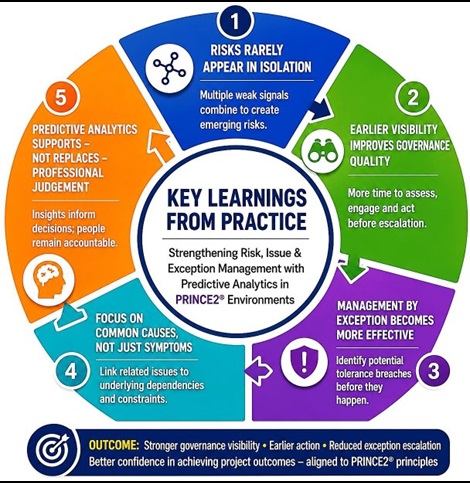
One of the most valuable observations from this experience was that project risks rarely emerged as isolated events. More often, they developed gradually through multiple weak signals distributed across supplier reports, issue logs, governance discussions, project schedules, and stakeholder communications. The challenge was not the absence of information, but recognizing meaningful relationships between seemingly unrelated events. By helping consolidate information from multiple sources, Microsoft Copilot supported a broader view of project performance and enabled patterns to be identified earlier than might have been possible through manual review alone.
A second observation was that predictive analytics delivered their greatest value through improved governance visibility rather than faster reporting. Within a PRINCE2 environment, governance decisions depend upon timely and reliable information. Earlier identification of emerging delivery concerns provided additional time for assessment, stakeholder engagement, and consideration of response options before escalation became necessary. This supported more informed decision-making while preserving the governance structure and accountability that remain fundamental to the PRINCE2 method.
The experience also highlighted how predictive analytics can strengthen the principle of management by exception. Rather than waiting for formal exception conditions to arise, governance bodies gained earlier visibility of trends that had the potential to affect agreed tolerances. This enabled greater focus on prevention and proactive intervention, helping project teams address concerns before project performance was materially impacted.
Lessons Learned
Three lessons stood out from this experience.
1. Predictive analytics is most effective when used to support professional judgement instead of replacing it.
2. The greatest value often comes from identifying connections between dispersed pieces of information rather than discovering entirely new risks or issues.
3. Earlier visibility creates opportunities for stronger governance discussions, more effective stakeholder engagement, and better-informed decision-making.
Within PRINCE2, these capabilities can enhance risk, issue, and exception management while reinforcing the principles of governance, accountability, and management by exception that underpin successful project delivery.
Governance considerations for practitioners
Despite its potential benefits, predictive analytics also introduces important governance considerations.
Project professionals must remain conscious of data quality limitations, incomplete reporting inputs, algorithmic bias, and overreliance on automated recommendations. Predictive outputs should support informed decision-making without creating false confidence in delivery certainty.
Governance assurance therefore becomes increasingly important. Assurance functions may need to validate not only delivery controls, but also the reliability, transparency, and interpretation of predictive insights used within governance processes.
For practitioners, this may also require the development of new skills. Project managers and governance leaders may increasingly need to understand how predictive indicators are generated, interpreted, and incorporated into governance discussions responsibly.
Ultimately, the future of project governance may depend as much on earlier recognition of emerging delivery signals as on better reporting. PRINCE2 already provides a strong governance foundation for structured decision-making, accountability, and controlled escalation. Predictive analytics may enhance that foundation by improving governance visibility and enabling more proactive intervention in increasingly complex delivery environments.
Conclusion
Ultimately, the future of project governance may depend not only on better reporting, but on earlier recognition of emerging delivery signals. My experience using Microsoft Copilot within a telecommunications delivery environment demonstrated that predictive analytics can strengthen governance visibility by bringing together fragmented project information and highlighting emerging delivery trends.
The greatest value came through enabling earlier and more informed governance discussions instead of automating decisions. Within PRINCE2 Project Management, this capability has the potential to enhance risk, issue, and exception management while preserving human accountability, professional judgement, and structured decision-making that remain central to successful project delivery.
 Lead author
Dr. Suman Ghosh is an ICT and cybersecurity professional with over 22 years’ experience in global project delivery, risk management and secure digital transformation. A Project Manager at BT Global Services and an ITIL and PRINCE2 Ambassador, he is passionate about ethical leadership, knowledge-sharing and developing future-ready technology professionals.